New Report: Higher Alberta Visitor Tax Impacts

Updated: Apr 28
Is the Juice Worth the Squeeze?
The Tourism Industry Association of Alberta (TIAA) has released its latest research report, 2026 Economic Impacts of Alberta Tourism Fee Increases and Political Uncertainty, which quantifies the mounting fiscal headwinds facing Alberta’s visitor economy. Technical economic analysis and a survey of Alberta tourism operators reveal a projected $164 million annual contraction in visitor spending and $271 million in sidelined private capital.
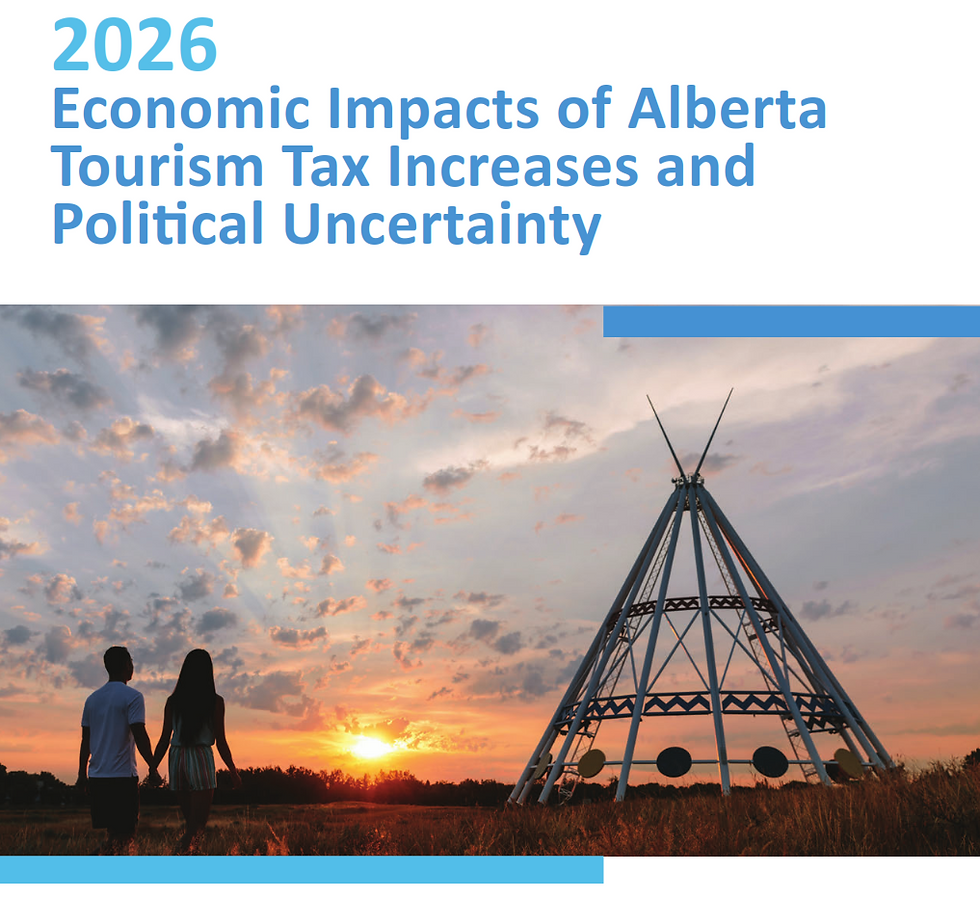
New Research Report Reveals the Economic Cost of Policy Volatility and the increased Tourism Levies
Alberta’s visitor economy has been recognized as the sleeper pick with significant tailwinds in our province’s diversification efforts. However, as the results of our newly released report, "2026 Economic Impacts of Alberta Tourism Fee Increases and Political Uncertainty," reveal, that momentum is currently facing increased economic pressure in addition to a fractious geopolitical climate, that threaten to stall our trajectory toward the provincial goal of a $25 billion industry.
Budget 2026-27 introduced a 50% hike to the Alberta Tourism Levy (ATL) and a new 6% Vehicle Rental Tax (VRT). While these moves are projected to generate $102 million in fresh general revenue for the province, the data from our survey of Alberta tourism operators and technical economic analysis suggests that for the broader economy, the tax juice simply isn't worth the squeeze.
The Squeeze: Price Elasticity, Visitor Behaviour, and Affordability
At the policy table, there is a temptation to view tourism as this seemingly inexhaustible resource that will simply absorb higher costs. The reality is far more human. When the cost of a hotel room or a rental car jumps, visitors don't just write a bigger check, they shorten their trips, skip the local restaurant, or look toward our neighbours in B.C. for their next getaway. Domestic visitors, who represent 75% of our spending, are highly price-sensitive.
Accommodation Impact
For every 1% increase in hotel taxes, room sales historically decline by 0.44%.
Transportation Impact
Rental car demand is similarly sensitive, with a price elasticity of -0.36. This means higher fees directly push travelers to cut their spending elsewhere in the community to balance their vacation budget.
The juice isn't worth the squeeze
These behavioral shifts are projected to trigger an immediate $164 million annual contraction in visitor spending, costing the province 813 jobs and $119 million in GDP from the direct spending hit alone with $22 million in forgone taxes across government.
An Investment Climate Under Pressure
Beyond the immediate loss at the cash register, the report highlights a concerning investment slowdown that effectively freezes the private capital needed to build tomorrow’s destinations. Market certainty is the primary driver of development, and currently, that certainty has been shaken.
42% of Alberta tourism businesses have already postponed (16%), scaled back (22%), or redirected (4%) their investments due to recent policy changes and current political conditions.
60% of operators expect the prospect of a 2026 separation referendum to significantly or moderately pause or delay their investment plans .
Estimated $271 million in private investment has been sidelined.
Notably, 69% of those reporting are located outside of the Jasper-Canmore-Banff regions .
When we factor in the lost spending associated with those stalled projects and the impacts of the tourism fee increases:
Alberta faces $1.2 billion less in future visitor spending
49 million less in provincial taxes and $32 million less in municipal taxes.
Maintaining Momentum Toward $25 Billion
Operator feedback in the survey indicated a hihg degree of frustration and a loss of confidence. Many operators felt that Alberta cannot afford to trade business and investor confidence for short-term tax gains. There is a prevailing sense that the industry has held up its end of the bargain; delivering record-breaking results and nation-leading growth in partnership with a commercially focused crown agency, only to be met with fiscal headwinds. These policy shifts undermine the industry’s efforts to attract the new private capital required to drive Alberta’s visitor economy toward our $25 billion revenue goal.
Modern economies can not afford to trade long-term business and investor confidence for short-term tax gains. While the strategic levers successfully executed through Travel Alberta have been extremely effective and will continue to drive performance within their mandate, these efforts alone cannot achieve the province's ambitious $25 billion goal articulated in the Higher Ground strategy.
Realizing this target necessitates a fundamental shift across many provincial ministries moving beyond treating tourism as a nice-to-have amenity and effectively supporting it as a foundational economic engine that drives prosperity. Critical commercial activation pillars remain a work in progress, requiring coordinated investment from multiple ministries alongside private capital. To bridge the gap to the $25 billion goal, the province will need to provide the level of regulatory and investment certainty required to be competitive in a fierce global market for capital.
Ultimately, success depends on ensuring that conditions on the ground are stable and predictable enough to attract and maintain the private sector investment in world-class tourism infrastructure required to deliver lasting economic returns for every corner of the province.
"The $25 billion provincial goal is a bold frontier that remains well within our reach, but only if Alberta sends a clear and consistent signal to investors that this is a place to build. Stability, competitiveness, and alignment are not optional. They are the foundation of sustained economic growth.”
Darren Reeder President & CEO
Tourism Industry Association of Alberta